






Evolution of Bronze Sculpture: From Ancient Civilizations to Modern Art
Bronze has been one of humanity’s most enduring artistic mediums for over five thousand years. Valued for its strength, ability to hold fine detail, and resistance to the passage of time, bronze has enabled sculptors to create works that survive long after civilizations fade.
The evolution of bronze sculpture closely mirrors that of culture, technology, and artistic creation.
The Bronze Age
Bronze sculpture began around 3500 BC, when artisans in the Middle East discovered that alloying copper with tin produced a harder, more reliable material. This innovation transformed tools and weapons, and soon, artistic expression.
One of the earliest known bronze figures, the Dancing Girl of Mohenjo‑Daro (c. 2500 BC), manifests remarkable confidence and naturalism in a piece only a few inches tall. In ancient Egypt, bronze was used to depict gods, animals, and pharaohs, while in the Shang Dynasty of China, monumental ritual vessels were decorated with symbolic motifs.
These early cultures developed the lost‑wax casting method, still used today, proving bronze’s unmatched ability to preserve movement, texture, and symbolism.
Classical Antiquity
Greek and Roman sculptors brought bronze sculpture to greater heights. They mastered the art of casting large, complex figures and achieved unprecedented realism in anatomy and movement.
The Greeks created life-sized bronze gods, athletes, and warriors. Most were later melted down for their metal, but surviving examples, such as the Riace Warriors, reveal extraordinary skill. The Romans continued this tradition, creating bronze portraits and equestrian statues.
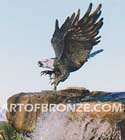
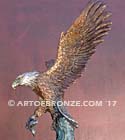
During this period, bronze eagle sculptures became prominent as powerful symbols of Zeus (Jupiter) and imperial authority. Roman legions marched with bronze eagle standards, and bronze eagle sculptures adorned temples and public buildings, elevating the bird’s representation in art and culture. The Middle Ages: Continuity Through Change
After the fall of Rome, bronze casting persisted through religious art. Byzantine and medieval European artisans cast church doors, baptismal fonts, and reliquaries. The bronze doors of Hildesheim Cathedral (c. 1015) demonstrate storytelling in relief sculpture, preserving spiritual narratives in metal.
Meanwhile, bronze craftsmanship flourished in Asia. Tang and Song Dynasty artists produced refined Buddhist figures and ritual objects, making certain that bronze sculpture remained a living tradition even as Europe transitioned through the Middle Ages.
The Renaissance
The Renaissance saw a revival of classical forms and techniques. Artists like Donatello, Ghiberti, and Verrocchio created bronze masterpieces that rivaled ancient works of art. Ghiberti’s bronze doors for the Florence Baptistery were called the “Gates of Paradise” by Michelangelo.
Benvenuto Cellini’s Perseus, with the Head of Medusa, demonstrates the virtuosity of Renaissance bronze casting. The complex pose, the flowing blood, and the detailed figures show what was possible when artistic vision met technical mastery.
Bronze eagle sculptures reappeared during this period, their form and fierce gaze emphasizing power in civic and ecclesiastical contexts.
Baroque and Rococo
Baroque artists infused bronze with movement and theatricality. Sculptors like Gian Lorenzo Bernini immortalized moments of divine intensity and powerful tension. Bronze fountains and ornamentation transformed urban spaces into emotional experiences.
During the Rococo period, bronze became popular in smaller decorative works, clocks, figurines, and ornamental objects that adorned refined domestic interiors.
The 19th Century
The Industrial Revolution expanded access to bronze casting, leading to an explosion in sculpture across Europe and America. The Animalier movement, led by Antoine‑Louis Barye, emphasized realistic and dynamic representations of animals.
Barye’s lion, tiger, and eagle sculptures in bronze conveyed raw strength and anatomical precision, impacting generations of wildlife sculptors. This period also saw the widespread erection of public monuments, in which eagles symbolized nationalism, liberty, and military power.
The 20th Century: Modernism and Beyond
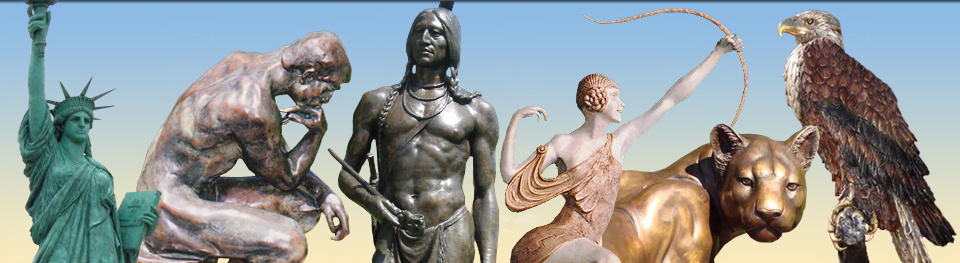
Modern artists reimagined bronze sculpture. Auguste Rodin brought depth of thought to the medium through works such as The Thinker and The Burghers of Calais. Constantin Brancusi simplified forms to their essence, as in his Bird in Space.
Abstract expressionists like David Smith and Anthony Caro used bronze in new ways, creating open, linear compositions. Henry Moore’s monumental bronzes explored the relationship between form and space.
Contemporary artists continue to challenge limits, using bronze alongside other materials and examining new subjects. Eagle sculptures in bronze, famous for their symbolism and dynamic forms, remain popular and are now interpreted in styles ranging from realistic to abstract.
Bronze Sculpture Today
At Art of Bronze, we celebrate this deep artistic legacy while adopting modern creativity. Our sculptures are made using time‑honored casting methods, guaranteeing each piece carries the depth, durability, and symbolic power that have defined bronze for millennia.
Explore the Art of Bronze collection now and discover a sculpture that celebrates the past while inspiring the present. Bring home a piece of history, cast in bronze, made to endure.